

Service / Technology Instance

About Structure-based Virtual Drug Screening, I2PC, Madrid, Spain

View All Data Analysis at Instruct

The Scipion-Chem Service enables researchers to transform structural information about biological macromolecules into actionable hypotheses for ligand binding and therapeutic development. The service provides a fully integrated environment for binding pocket identification, ligand docking, and virtual screening, allowing users to start with experimentally determined or modeled 3D structures and rapidly generate ranked lists of potential ligands. Users can submit their structures and (optionally) their own compound libraries or access curated public collections to explore new binding sites, prioritise hits, and guide experimental validation.

 
Input Data

The service requires as input a 3D atomic structure of the target macromolecule. The user may optionally provide a library of small molecules in SMILES format; otherwise, the screening will be performed against a curated set of ~1500 FDA-approved compounds.


Analysis Types

Scipion-Chem offers two main types of analyses:

  1. Druggable Pocket Search. This analysis identifies potential ligand-binding sites on the surface of the provided structure. The algorithm detects cavities and evaluates their physicochemical properties—such as hydrophobicity, charge distribution, and geometric accessibility—to estimate their likelihood of accommodating drug-like molecules. The analysis is performed on the static input conformation; no molecular dynamics sampling of alternative conformations is executed at this stage.
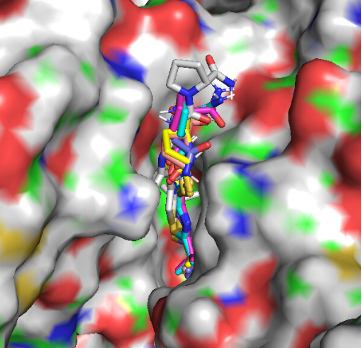
  2. Drug Binding Prediction. Once pockets are identified, a virtual screening campaign can be launched against the selected pocket(s). Each compound from the chosen drug library is docked onto the target structure, and binding affinities are estimated through molecular docking and scoring protocols. The output includes the predicted binding poses, ranked affinities, and interaction maps between the ligand and the target.


Output and Visualization

Results are fully integrated within the Scipion environment, providing interactive 3D visualization of druggable sites, binding poses, and ranked compound lists. The outputs can be exported for further refinement, such as molecular dynamics simulations or medicinal chemistry optimization.


Use Case

This service enables Instruct users to derive early insights into the druggability of newly solved macromolecular structures and to generate experimentally testable hypotheses about potential ligands. The integration into Scipion ensures traceability, reproducibility, and interoperability with other Instruct pipelines, including those for cryo-EM data processing and atomic model refinement.

Service Availability:

Remote

Physical

Instruments Available:

Execution of a pocket finding or virtual drug screening workflow

User Guide

The Scipion-Chem Service is open to all Instruct-ERIC users who wish to apply pocket identification and ligand docking to their biological macromolecules. The main entry point to the service is an experimental atomic structure of your target (for example a cryo-EM, X-ray crystallography or NMR-derived model). Using this structure as input, Scipion-Chem can identify and characterise potential binding pockets, prepare ligand libraries, and perform docking and scoring within a fully reproducible workflow.
 
To make the most of the service, visitors should prepare:
 
1. A validated atomic model of the target macromolecule in a standard format (PDB or mmCIF).
2. Optional ligand libraries or compound lists if specific molecules are to be screened; otherwise public libraries can be provided.
3. Any biological context or constraints relevant to binding (e.g. cofactors, mutations, known active sites).
 
During the visit, users will work with the Scipion-Chem team to define the most appropriate workflow for their project, review intermediate results, and learn how to visualise and interpret docking outcomes. All analyses performed during the visit will be fully documented and made available for download after completion, ensuring transparency and reproducibility.
 
User Guide:

Address: c/Darwin, 3, 28049, Madrid, Spain

Facility weblink: https://i2pc.es/

Physical access: yes

Remote access: yes

Average time of a visit: 4 days

Information about sample preparation: The service requires as input a 3D atomic structure of the target macromolecule
Instruct Centre

Instruct-Madrid

Madrid

Madrid

Spain

 Structure-based Virtual Drug Screening, I2PC, Madrid, Spain

Contacts:

Carlos Oscar Sanchez Sorzano
Spanish National Research Council
Login to contact
Blanca Elena Benitez Silva
Spanish National Research Council
Login to contact