
We have applied some changes to ARIA and are monitoring stability, but you can continue to work as normal. We appreciate your understanding.
View All Solution NMR at Instruct
View All Magnetic Resonance Techniques at Instruct
Electron Paramagnetic Resonance (EPR)-based methods have been used to map local dynamic and structural features of biomolecules, to explore different modes of biomolecule-ligand interaction, to obtain long-range structural restraints and to probe metal-ion-binding sites.
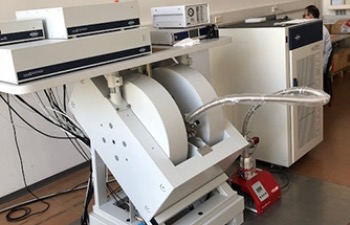
Our EPR instrument con be used either in Continuous-wave X-Band or Continuous-wave/Pulse Q-Band configurations. EPR measurements can be performed on biological samples containing paramagnetic metal ions (i.e. Fe, Cu, Mn etc.) or free radicals, or on samples that have been labelled with paramagnetic tags (e.g. spin labels). The pulse Q-band EPR instrumentation present at CERM/CIRMMP can be used to measure ESEEM, HYSCORE, ENDOR and DEER experiments.
EPR spectra can be recorded at different temperatures, between room temperature down to 4K. For cryogenic conditions, including pulsed Q-band measurements, samples must be previously frozen, ideally in a glassing state. For aqueous samples, 40%-10% v/v glycerol or EG, or ~0.4 M sucrose, or other sugars like trehalose can be used as a glassing agent.
Spectrometer Q-Band CW/FT-EPR ELEXSYS E580 with the possibility of operating in CW-X-band.
All tubes and capillaries should be filled to the same volume. Sample heights are in addition to the hemi-spherical tube bottom. If there are issues with the amount of sample available, we may be able to work with smaller volumes. However, we suggest to use the preferred sample heights to fill completely the EPR cavities in order to have spectra with high signal-to-noise ratio.
Preferred:
EPR spectra can be recorded at different temperature, between 298K and 4K. For cryogenic conditions and pulsed Q-band measurements, samples must be previously frozen.
The support offers sample preparation, instruments setup, data acquisition and data analysis. Based on the visiting scientist expertise assistance and supervision will be assigned.
Before their visit, the visiting scientist must communicate the scientific plan of the experiments and the contacts to arrange the visit. Visits to the facilities may range from one day to weeks, depending on the complexity of the work to be performed and the experience of the visiting scientist in the field.
For remote access, if the samples are not shipped in the quartz EPR tube, our staff takes care to transfer it from the vial to the tube; air-sensitive samples will be handled in an oxygen-free chamber. Our staff will operate following the protocol for operations (air/light sensitivity, temperature of storage, etc…) provided together with the samples.