03-Nov-2026
Understanding the structural mechanisms governing protein dynamics is essential for uncovering their functions and contributions to disease and for advancing drug discovery research. Nuclear magnetic resonance (NMR) spectroscopy is a powerful structural biology technique that enables researchers to investigate protein conformation and molecular interactions.
This technique requires proteins to be enriched with stable isotopes, such as 15N and 13C, which is most routinely achieved via recombinant expression in prokaryotic systems like Escherichia coli (E. coli). However, human proteins contain post-translational modifications and often form large complexes, which can make bacterial expression systems unsuitable. In these situations, eukaryotic expression systems such as yeast, mammalian or insect cells, are used instead. In these systems, producing isotope-labelled proteins can be particularly challenging, with incorporation efficiencies modest and variable.
In a recent study, researchers at the Goethe University Frankfurt (GUF) investigated Cupriavidus necator (C. necator) as an alternative source of stable isotopes for protein production in insect cells. This bacterium can generate biomass enriched with 15N and 13C, which can be used directly or processed into a protein hydrolysate before use as a nutrient supplement in cell culture media. The researchers tested this approach using Sf9 insect cells to express the kinase domain of EPHA2, a receptor tyrosine kinase implicated in colorectal cancer progression and a potential target for therapeutic inhibitor development.
Preliminary experiments indicated that C. necator biomass or protein hydrolysate exhibited no toxicity (Figure 1A,B), and the production of EPHA2 protein verified its bioavailability to Sf9 cells, equivalent to other commercial extracts (Figure 1C). These also highlighted that expression was consistently higher with protein hydrolysates compared with biomass, indicating the importance of hydrolysates in improving amino acid availability under restrictive growth conditions.
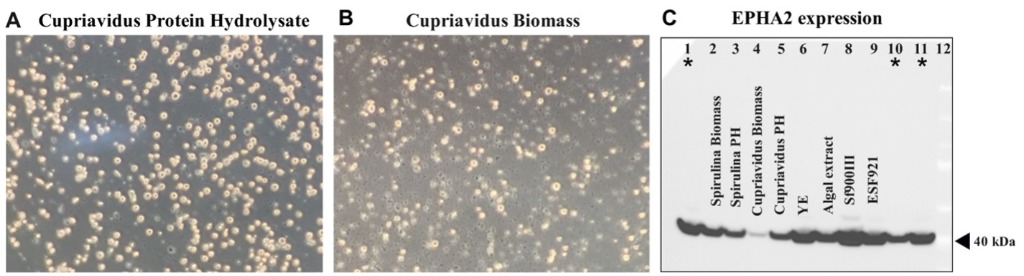
Figure 1. (A,B) Sf9 cell growth with Cupriavidus necator extracts & EPHA2 expression. Microscopic images of Sf9 insect cells cultured in media with Cupriavidus necator supplement in a deep-well plate. The image shows cells with typical rounded morphology of healthy proliferating cells and smaller black bodies of lysed cells. Image captured at 100x magnification.(C) His-tagged EPHA2 expression in Sf9 cells under different supplementation conditions was assessed by Western blot using anti-His antibody.
The team then evaluated the incorporation of stable isotopes into EPHA2 using liquid chromatography-mass spectrometry (LC-MS) and assessed the protein’s folding using NMR spectroscopy. Under optimised conditions, the C. necator-derived protein hydrolysate supported 15N incorporation of up to 79% and 13C incorporation of up to 69%. NMR spectra also showed that the 15N-labelled EPHA2 retained a well-folded, homogeneous structure. Notably, when compared under matched conditions, the C. necator protein hydrolysate supported higher protein yields than Spirulina protein hydrolysate while achieving comparable levels of nitrogen isotope incorporation.
The study also highlighted that isotope incorporation and protein yield depend not only on the isotope source, but also on the composition of the culture medium and how cells are adapted to it. Although carbon and dual-isotope labelling were feasible, these approaches substantially reduced protein yield under some conditions, illustrating the need to balance isotope enrichment with the amount of protein recovered.
Together, these findings establish C. necator as a promising alternative biological system for stable-isotope labelling in eukaryotic protein expression systems.
Dr Santosh Gande, lead author, concluded: “This work establishes Cupriavidus necator as a promising alternative source of stable isotopes, expanding the possibilities for NMR studies of challenging human proteins expressed in eukaryotic systems. The approach opens new opportunities for structural investigations of disease-relevant proteins and supporting structure-based drug discovery.”
The work was supported by access to the Centre for Biomolecular Magnetic Resonance (BMRZ), an Instruct-ERIC centre. Dr Gande commented: “Access to the advanced NMR infrastructure and expertise at the Instruct-ERIC Centre for Biomolecular Magnetic Resonance (BMRZ), Goethe University Frankfurt, enabled the structural characterisation and validation of isotope-enriched proteins.”
This scientific highlight was written by María Hernández Mustieles, Ludwig Institute for Cancer Research.